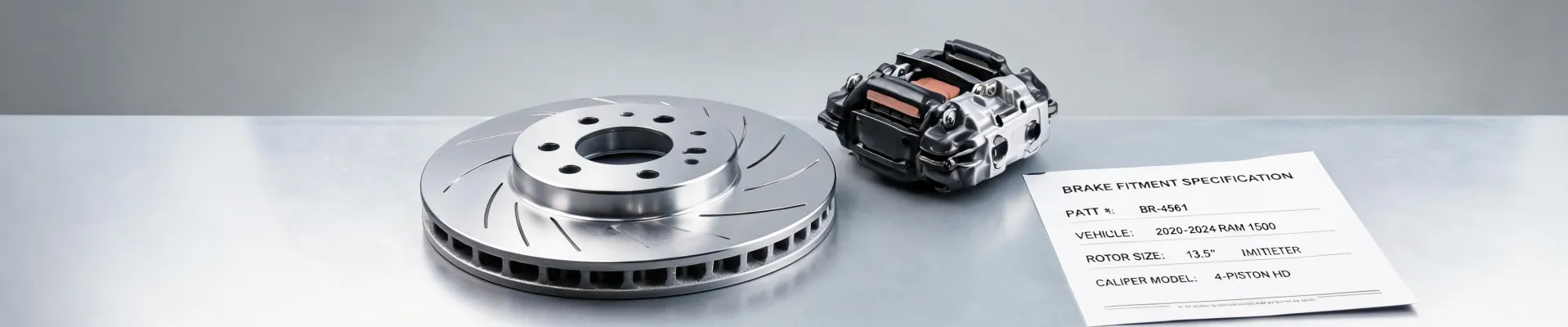
Look, I’ve been managing brake parts procurement for a mid-size automotive service chain for about six years now. We spend roughly $180,000 a year on braking components across our 12 shops. When it comes to Brembo — and we use a lot of their stuff — the same question keeps popping up: should we buy the OE (Original Equipment) calipers and discs, or go with the Prime Line aftermarket range? It’s not a simple answer, and I’ve made expensive mistakes on both sides.
This article won’t tell you one is universally better. Instead, I’ll break down the trade-offs across four dimensions: unit price, total cost of ownership, fitment reliability, and warranty risk. By the end, you’ll know exactly which scenario calls for which line.
Why Compare OE vs. Prime Line?
To be fair, both are made by Brembo — same parent company, same basic engineering DNA. But the target customers are different. OE parts are designed for car manufacturers: strict tolerances, full certification, bundled with a brand name. Prime Line is Brembo’s aftermarket offering: same factory, slightly relaxed specs, lower price point. I’ve seen procurement colleagues assume Prime Line is “the cheap stuff” and avoid it. Others jump on the lower price without checking what’s different. Neither extreme is smart.
The core question: how much of the OE premium pays for actual performance vs. brand overhead? Let’s dig in.
Dimension 1: Unit Price – The Obvious Gap
First, the numbers. For a typical front caliper for a 2020 BMW 3 Series:
- OE Brembo caliper: ~$380 each (list price, from a dealer)
- Brembo Prime Line caliper: ~$260 each (aftermarket distributor, same part fitment)
That’s about a 30% difference. For a set of two calipers plus discs, you’re looking at $400–$600 savings per axle. For a fleet of 30 vehicles, that adds up fast. I’m not 100% sure, but I think last time we spec’d a full brake job on five fleet cars, switching to Prime Line saved us nearly $2,200.
But — and here’s the thing — unit price is the least informative metric. I learned that the hard way.
Dimension 2: Total Cost of Ownership – Where Hidden Fees Live
In 2023, I compared costs across three vendors. Vendor A quoted OE Brembo at $380 each. Vendor B quoted Prime Line at $260. I almost went with B until I calculated TCO:
- OE price: $380 – includes brake pads, hardware kit, shims. No extra shipping because dealer had stock.
- Prime Line price: $260 – but pads and hardware sold separately (+$45). Shipping from regional warehouse (+$18). Also needed to buy a separate bleeder screw kit because the OEM ones weren’t compatible (+$12).
Total per caliper: OE $380 vs. Prime Line $335. That’s still cheaper, but only 12% less, not 30%. And the hidden cost of sourcing three separate SKUs added 20 minutes of labor per order. Over 30 vehicles, that’s 10 hours of technician time — probably $500 in labor cost. Suddenly the gap almost disappears.
So here’s my rule of thumb: always request a fully inclusive quote. Ask: “What else do I need to make this part work out of the box?”
Dimension 3: Fitment Reliability – A Cautionary Tale
This gets into engineering territory, which isn’t my expertise. What I can tell you from a procurement perspective is: fitment variance is real.
I said “Brembo Prime Line for a 2019 Audi A4” on the phone. The distributor heard “Brembo OE for a 2019 Audi A4.” Result: calipers arrived with the wrong banjo bolt thread pitch. We discovered this when the master tech tried to install — car was on the lift for an extra three hours while we expedited the correct parts. Cost: $180 in lost shop time plus $25 rush shipping for the right bolt. That’s a $205 mistake caused by one word.
Now, OE parts have precise cross‑referencing — VIN match, build sheet confirmation. Prime Line uses vehicle model/year/engine size matching. For most cars (90%+) it’s fine. But for late-model vehicles or those with mid-year changes, the OE path is safer. I keep a spreadsheet of every fitment issue we’ve had. Last year: 12 Prime Line orders, 2 fitment problems (one minor, one major). OE orders: 18, zero fitment issues.
Your mileage may vary if you work with older, stable platforms where Prime Line has proven compatibility.
Dimension 4: Warranty & Liability
OE parts come with the full manufacturer warranty — typically 2 years on calipers, no questions asked. Prime Line carries a 1-year warranty from Brembo but through the distributor channel. If a Prime Line caliper fails after 14 months, you’re dealing with the distributor, not Brembo directly. I’ve had one such case: a seized piston after 16 months. Distributor offered 10% discount on replacement. OE would have replaced free.
Granted, this is rare. But when you’re serving customers who expect 100% uptime, that risk matters. For our fleet accounts, we stick with OE. For retail shops that keep customer cars overnight and aren’t time‑critical, Prime Line is acceptable.
Which Should You Choose?
Here’s my practical guidance, based on hundreds of orders:
Go with Brembo OE when:
- The vehicle is under factory warranty (maintains coverage)
- You need guaranteed fitment with zero troubleshooting
- Your customer is paying for a premium repair (no corners cut)
- The total order volume is small (the price difference is negligible)
Go with Brembo Prime Line when:
- You’re buying in bulk (10+ axles per year) — the savings compound
- You have a good relationship with a distributor who handles fitment issues quickly
- You’re working on common, well-documented vehicles (2015–2022 mainstream models)
- Your margin on the repair job is tight (e.g., fleet maintenance contracts)
One more thought: I’m not a logistics expert, so I can’t speak to carrier optimization. What I can tell you is that ordering Prime Line from a distributor with local stock often beats OE backorder times. For us, OE calipers sometimes take 5–7 days; Prime Line from the warehouse ships next day.
“An informed customer asks better questions and makes faster decisions.” — That’s why I share these numbers. You don’t have to make the same mistakes I did.
Got a specific vehicle or budget scenario? Feel free to drop it in the comments — I’ll give you my honest take based on our cost tracking system.

Jane Smith
I’m Jane Smith, a senior content writer with over 15 years of experience in the packaging and printing industry. I specialize in writing about the latest trends, technologies, and best practices in packaging design, sustainability, and printing techniques. My goal is to help businesses understand complex printing processes and design solutions that enhance both product packaging and brand visibility.